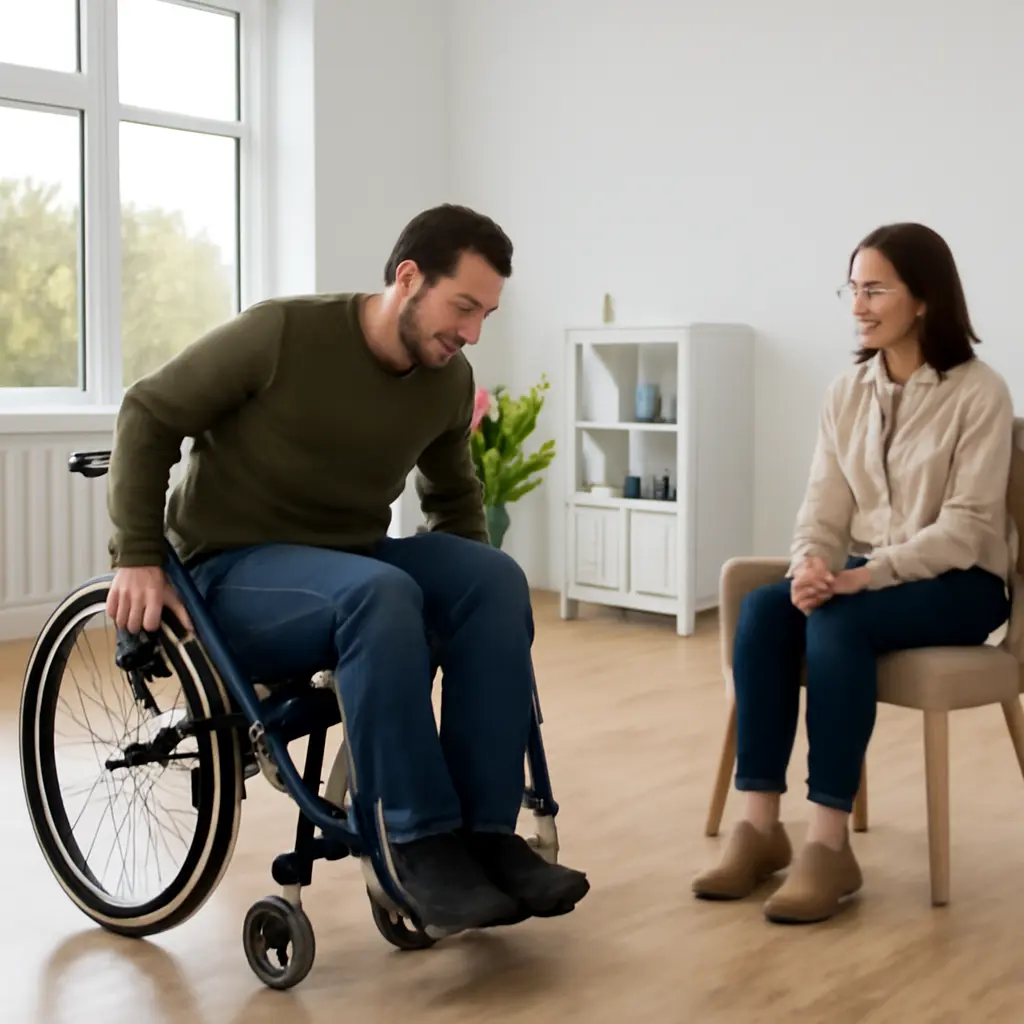
Assistive technology helps wheelchair users live more independently by making movement, communication, personal routines, and access to work and community life easier to manage. The World Health Organization (WHO) estimates that 80 million people worldwide need a wheelchair, while access to an appropriate one remains uneven. From individually fitted manual and powered chairs to smart-home controls and accessible digital tools, the right technology can reduce reliance on another person for everyday tasks. Its benefits depend on more than the device itself: assessment, fitting, training, maintenance, and accessible environments all matter.
Wheelchair assistive technology supports independent mobility
Assistive technology is an umbrella term for products and related services that help people maintain or improve functioning, independence, and participation. WHO describes assistive technology as products and associated systems and services for people with disabilities, health conditions, or age-related limitations. In wheelchair use, it includes the chair, seating and positioning components, controls, access adaptations, and the professional services needed to select and support them.
A wheelchair is not simply a means of transportation. A properly selected and fitted chair can support posture, comfort, pressure management, and access to home, education, employment, health care, and social life. WHO’s wheelchair guidance emphasizes that effective provision involves assessment, fitting, user training, and follow-up—not just handing someone a product. This distinction is important: a chair that does not fit a person’s body, surroundings, or daily needs may limit rather than expand independence.
Manual wheelchairs and individualized seating
A manual wheelchair is propelled by the user, a companion, or both. Lightweight frames, adjustable components, and carefully chosen wheel positions can make self-propulsion easier for some users. Seating systems—such as cushions, back supports, and positioning features—are selected to help meet individual needs for stability, comfort, posture, and pressure distribution. A clinician or seating specialist can help match these features to the user’s body, abilities, and daily activities.
Manual chairs can support independence when the user has the strength, stamina, and environment needed to propel them. However, slopes, long distances, uneven ground, and repetitive effort can create barriers. WHO’s wheelchair provision guidance accordingly treats assessment and training as essential elements of service, rather than assuming one manual design suits everyone.
Powered wheelchairs and alternative controls
A powered wheelchair uses an electric motor and battery to move, with controls selected to suit the user. A joystick is common, but switches, head arrays, sip-and-puff systems, or other interfaces may be considered when standard hand controls are not accessible. Powered seating functions, where prescribed, can help users adjust position without another person physically moving the chair.
Powered mobility may expand a person’s ability to travel independently when manual propulsion is impractical or exhausting. That does not make it a universal choice: indoor turning space, doorways, charging, transport, maintenance, and the user’s control needs all affect suitability. Assessment and practice help users learn safe operation in the places where they actually live and travel.
Service, fitting, and maintenance are part of the technology
Wheelchair services include evaluation, prescription, fitting, training, repair, and follow-up. WHO’s guidelines for wheelchair provision present these as connected steps in a service pathway. They matter because a user’s needs may change, equipment can wear out, and even a well-chosen chair may become difficult to use if it is not maintained or adjusted.
A practical example is a user whose daily journey includes a narrow home doorway, an uneven path, and public transport. The right solution may require more than choosing a chair: it may involve adjusting the chair’s dimensions, identifying a suitable access route, practicing transfers, and arranging reliable repairs. This illustrates how assistive technology works best when the device and the user’s surroundings are considered together.
Wheelchair technology connects mobility with daily living
Mobility is a foundation for independence, but everyday participation also depends on being able to communicate, control one’s environment, and use services. The WHO and UNICEF Global Report on Assistive Technology estimates that more than 2.5 billion people need one or more assistive products worldwide; it projects that this may rise to 3.5 billion by 2050. The report also describes a substantial access gap, underscoring that technology’s potential is not realized when products and services are unavailable or unaffordable.
Smart-home controls and environmental access
Environmental control systems let a person operate household devices—such as lights, doors, thermostats, phones, or entertainment systems—using an accessible interface. Depending on the user’s needs, controls may include switches, voice commands, a smartphone, or integration with a powered wheelchair. These tools can reduce the need to ask another person for help with routine actions.
For example, someone who cannot easily reach a wall switch may use a voice assistant or adapted control to turn on a light. The usefulness of that setup depends on reliable connectivity, accessible interfaces, privacy choices, and backup options if the system fails. Technology supplements accessible housing; it does not replace basics such as clear circulation space, reachable controls, and usable doorways.
Communication and computer access
Accessible communication technology can help wheelchair users make calls, send messages, use online services, and participate in work or education. Depending on a person’s movement and communication needs, access may involve voice recognition, screen readers, alternative keyboards, switches, or mounting a device within reach. These tools address barriers that a wheelchair alone cannot solve.
Digital access is especially relevant when appointments, learning, work, and public information are delivered online. A device is not automatically accessible simply because it is digital: software, websites, and physical controls must work with the user’s chosen access method. Matching the interface to the person and providing training can turn a computer or phone into a practical tool for greater autonomy.
Transport, work, and community participation
Wheelchair technology can support participation outside the home, but independence also relies on accessible transportation and buildings. A suitable chair may help a user reach a workplace or community activity, while vehicle adaptations, accessible transit, ramps, elevators, and step-free routes determine whether the destination is usable. The United Nations Convention on the Rights of Persons with Disabilities recognizes access to personal mobility and assistive devices as important to independence and participation.
Consider a powered-chair user commuting to work: the chair may enable independent movement at home and on the sidewalk, but an inaccessible bus stop or broken elevator can interrupt the journey. This real-world pattern shows why outcomes cannot be attributed to equipment alone. Accessible infrastructure, respectful services, and dependable repair support are part of the same mobility system.
Appropriate wheelchair technology depends on the person and the setting
“Appropriate” means that a product fits the user’s needs, preferences, body, activities, and environment. WHO’s wheelchair guidance uses an individualized service approach: professionals and users work together to assess requirements, select and fit equipment, provide training, and arrange follow-up. The principle applies beyond wheelchairs as well: a device’s value comes from how well it works in the user’s real life.
Assessment and user choice
Assessment considers factors such as mobility, posture, comfort, daily routines, home layout, transportation, and the user’s goals. It should also take account of the user’s preferences and experience. A chair chosen without understanding those factors may be difficult to propel, uncomfortable to sit in, or unsuitable for everyday routes.
User choice matters because independence is not one fixed outcome. One person may prioritize a lightweight manual chair for travel; another may need powered mobility and alternative controls to move around without exhausting effort. Collaborative decisions help align the equipment with what the person wants to do.
Training, repairs, and affordability
Training helps users learn to operate, maintain, and safely use their equipment in relevant situations. Follow-up can identify fit problems or changing needs, while repair services help prevent a breakdown from removing access to work, care, or community life. WHO’s service guidance treats these supports as integral to effective wheelchair provision.
Cost and availability remain major barriers. The WHO–UNICEF Global Report on Assistive Technology documents a worldwide gap between the need for assistive products and access to them. Coverage varies by country and product, so users may face delays, limited choices, or out-of-pocket costs. Policymakers and service providers can improve access through sustainable funding, trained personnel, local repair capacity, and procurement that includes user needs.
Accessibility and the built environment
A wheelchair works within an environment, not apart from it. Door widths, ramps, elevators, flooring, curb cuts, accessible bathrooms, and usable transport all affect whether a person can move independently. When environments are designed to be accessible, a wider range of users can benefit; when they are not, even advanced equipment may be unable to overcome the barrier.
The World Health Organization’s International Classification of Functioning, Disability and Health recognizes that functioning is shaped by interactions between a person and environmental factors. This perspective helps explain why independence is not solely a measure of an individual’s physical ability or equipment. It is also shaped by whether society removes barriers and provides appropriate support.
Conclusion: assistive technology expands choice and participation
Wheelchairs, seating systems, alternative controls, smart-home devices, and accessible communication tools can help users manage movement and daily tasks with greater autonomy. The strongest results come when those products are appropriately selected, fitted, taught, maintained, and supported by accessible homes, transport, and public spaces. Global estimates from WHO and UNICEF show both the scale of assistive technology need and the importance of closing access gaps.
Users and families can begin by discussing personal goals with a qualified rehabilitation or wheelchair service professional and asking about assessment, trial, training, funding, and repair options. Communities and decision-makers can help by improving accessible design and investing in reliable assistive technology services. Further reading from WHO and UNICEF can help readers understand wheelchair provision and the broader global case for assistive technology.
Sources: World Health Organization, Wheelchair provision guidelines, https://www.who.int/publications/i/item/9789240074521; World Health Organization and UNICEF, Global Report on Assistive Technology, https://www.who.int/publications/i/item/9789240049451; World Health Organization, Assistive technology, https://www.who.int/news-room/fact-sheets/detail/assistive-technology; United Nations, Convention on the Rights of Persons with Disabilities, https://www.un.org/development/desa/disabilities/convention-on-the-rights-of-persons-with-disabilities.html; World Health Organization, International Classification of Functioning, Disability and Health (ICF), https://www.who.int/standards/classifications/international-classification-of-functioning-disability-and-health