Clinicians choose wheelchair cushions by matching a person’s posture, skin and pressure-injury risk, mobility, comfort, and daily environment to a cushion’s material and shape, then checking the fit in the actual wheelchair. A cushion is not selected by price or product label alone: the World Health Organization’s wheelchair-service guidance treats assessment, fitting, training, and follow-up as parts of an ongoing service. The decision matters because pressure injuries can have serious consequences, and the U.S. Centers for Disease Control and Prevention estimates that about 2.5 million people in the United States develop pressure injuries each year across care settings. Here is how professionals assess risk, compare cushion types, test positioning and pressure management, and review the result over time.
Clinicians’ cushion selection: a person-centered clinical decision
A wheelchair cushion is the seating surface placed between the user and the wheelchair, designed to support posture and distribute load. The RESNA (Rehabilitation Engineering and Assistive Technology Society of North America) position paper on wheelchair seating describes seating as a clinical intervention that should address function, postural support, comfort, and tissue protection—not simply provide padding. In practice, clinicians such as occupational therapists, physical therapists, and seating specialists weigh the person’s medical history and goals against the wheelchair’s dimensions and the cushion’s performance.
The first question is not “Which cushion is best?” but “What problem must this cushion solve for this person?” A user with intact sensation, stable posture, and independent weight shifts may need a different setup from someone with reduced sensation, pelvic obliquity, limited ability to reposition, or a history of pressure injuries. Assessment commonly considers the skin, sensation, posture, movement, transfers, continence, time spent seated, home and work surfaces, and ability to maintain or care for the cushion.
Assessment begins with risk, goals, and daily routine
Pressure-injury risk is evaluated alongside the person’s priorities. Clinicians ask about previous wounds, pain, changes in skin color, sensation, circulation, nutrition, and how long the person sits without repositioning. They also observe how the person moves, transfers, and performs pressure-relief maneuvers. A cushion that performs well during a brief clinic visit may not work if it makes transfers harder, is too heavy to manage, or requires maintenance the user cannot reliably perform.
The National Pressure Injury Advisory Panel defines a pressure injury as localized damage to the skin and/or underlying tissue, usually over a bony prominence or related to a medical device. That definition helps explain why cushion choice is only one part of prevention: posture, exposure time, skin checks, repositioning, and overall health also matter. A cushion does not eliminate pressure-injury risk.
Posture and function shape the prescription
Clinicians examine pelvic position, spinal alignment, hip range of motion, leg length, and whether the person can sit upright without sliding or leaning. A contoured cushion may help stabilize the pelvis and thighs; a flatter surface may be preferable when the user needs easier transfers or has a flexible posture. The chosen seat height and cushion thickness must also preserve access to the wheels, foot supports, tables, and transfer surfaces.
For example, a person with a fixed pelvic tilt may need a cushion shaped to accommodate that posture rather than force the pelvis into a position the body cannot tolerate. By contrast, a person who can reposition independently may benefit from a less restrictive surface that allows movement. The clinical goal is supported, functional sitting—not making every user conform to one ideal posture.
Cushion materials: clinicians compare pressure management, stability, and care needs
Cushion materials differ in how they deform under load, spread pressure, support movement, and respond to heat, moisture, and maintenance. RESNA’s seating guidance and the U.S. Department of Veterans Affairs’ wheelchair-seating resources emphasize matching the device to the user and evaluating it in use. No material is universally superior: a highly immersive cushion may improve pressure distribution for one person but feel unstable or make transfers difficult for another.
Foam cushions: simple, shaped support
Foam cushions use resilient or viscoelastic foam to provide support and distribute load through deformation. They are available in flat or contoured designs and can be relatively light, straightforward to handle, and easier to use during transfers. Clinicians may select shaped foam to support the pelvis and thighs or to accommodate a particular posture.
Foam can compress or lose resilience over time, so its condition and fit require review. A cushion that has bottomed out or developed uneven wear may no longer provide the intended support. Clinicians also consider heat retention, cover fit, and whether the foam’s contour interferes with the person’s movement or transfers.
Air-cell cushions: adjustable immersion and envelopment
Air-cell cushions use interconnected or individual air compartments to allow immersion—the extent to which a body part sinks into the cushion—and envelopment, or how closely the surface conforms around it. These properties can help redistribute load, but performance depends on correct inflation, user positioning, and ongoing checks. Clinicians teach users or caregivers how to inspect inflation and identify problems such as leaks or bottoming out.
An air cushion may suit someone at elevated pressure-injury risk, but it is not automatically the right answer. Some users find an air surface less stable, and others may have difficulty checking or maintaining it. A fitting appointment should verify that the person is supported without sinking so far that transfers, balance, or foot placement become unsafe.
Gel and fluid-based cushions: conformity and temperature considerations
Gel or fluid-based cushions use a deformable layer to conform to the body and spread load. Some combine gel with foam or other materials to balance pressure management and stability. Their weight, temperature behavior, and tendency for the material to shift are practical considerations. The clinician checks that the gel remains appropriately positioned and that the cushion is not excessively heavy for the user’s routine.
These designs can be useful when a person needs a conforming surface but does not tolerate an air cushion. However, product categories alone do not predict an individual outcome; the person’s posture, skin response, and ability to manage the cushion matter more than a material name.
Hybrid cushions: combining support characteristics
Hybrid cushions combine materials—for example, a contoured foam base with an air or fluid insert—to balance stability, positioning, and pressure distribution. A clinician may consider a hybrid when a single material does not meet competing needs, such as pelvic support and pressure redistribution. The trade-off is that more complex constructions can require extra fitting, cleaning, inspection, or replacement planning.
Cushion fitting: clinicians verify dimensions, posture, and pressure response
A cushion’s effectiveness depends on fit as much as material. The clinician checks seat width and depth, cushion orientation, pelvic position, thigh support, foot placement, and whether the user remains stable during ordinary activities. The cushion should be compatible with the wheelchair’s seat and cover; an improperly sized or positioned cushion can reduce its intended support and may create sliding or pressure points.
Static and dynamic checks during a seating trial
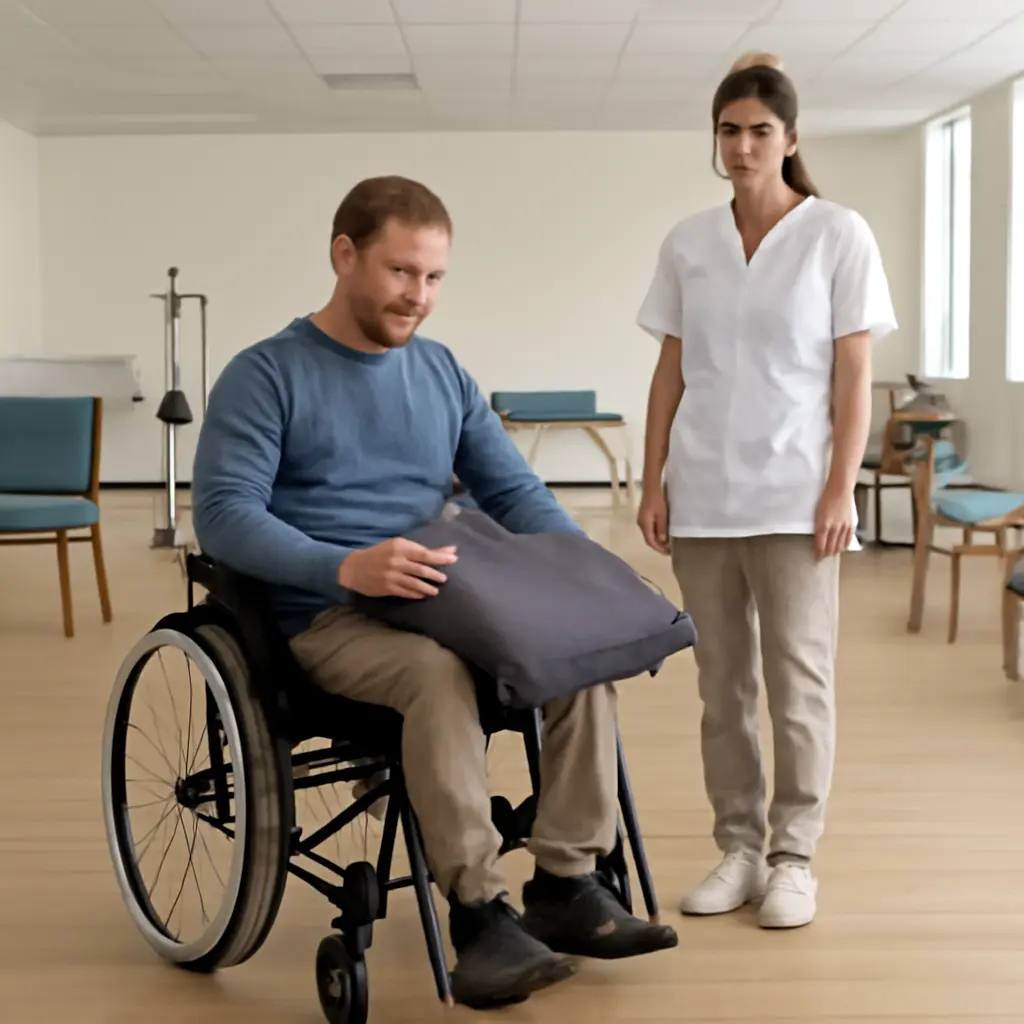
During a trial, the clinician observes the user sitting at rest and moving: reaching, propelling, transferring, and performing pressure relief if able. They look for pelvic sliding, asymmetry, excessive sinking, instability, and contact between the body and hard wheelchair components. The user’s feedback is essential because discomfort, heat, difficulty transferring, or fatigue may appear only after a period of use.
Pressure-mapping systems can display relative pressure at the seating interface and may help compare positions or identify areas for further assessment. They are an adjunct, not a stand-alone diagnostic test: readings depend on the sensor system and setup, and a pressure map cannot by itself establish whether tissue will be injured. Clinicians interpret it alongside skin history, posture, sensation, and real-world function.
The wheelchair and cushion must work as one system
Cushion thickness changes the user’s seated height, which can affect access to hand rims, desk surfaces, footrests, and transfer levels. Seat width and depth influence pelvic and thigh support, while back support and foot positioning affect the load borne by the seating surface. Professionals therefore assess the complete seating system rather than treating the cushion as an isolated accessory.
A practical example is a user who sits comfortably on a thick cushion but can no longer reach the wheels efficiently. The clinician may need to adjust the wheelchair setup or trial a different cushion profile. Comfort in one position is not enough if the overall configuration compromises mobility or safety.
Follow-up and prevention: the prescription changes with the person
A cushion prescription is not a one-time decision. Changes in weight, posture, strength, sensation, skin condition, medical status, or daily routine can alter the fit and the person’s risk. The WHO’s Guidelines on the Provision of Manual Wheelchairs in Less Resourced Settings emphasize appropriate assessment, fitting, user training, and follow-up as linked components of wheelchair provision.
Training covers checks, cleaning, and pressure relief
Users and caregivers should know which side faces up, how the cushion is positioned, how to check its condition, and how to clean it according to the manufacturer’s instructions. For air cushions, training may include checking inflation. For all types, regular inspection can identify cover damage, flattening, shifting inserts, or other changes that affect fit.
Clinicians also discuss individualized pressure-relief strategies and skin inspection. The appropriate method and schedule depend on the person’s abilities and clinical circumstances; there is no single interval that should be applied to everyone without assessment. New redness that does not fade, persistent discomfort, or skin breakdown warrants prompt clinical review.
Reassessment responds to warning signs and life changes
Follow-up is especially important after a pressure injury, major change in mobility, surgery, weight change, or a new difficulty with transfers or sitting tolerance. A cushion that once fitted well may become unsuitable as the user’s body or wheelchair setup changes. Early reassessment can identify a problem before it becomes a more serious injury or limits participation.
The broader evidence also shows why prevention matters. The CDC’s estimate of approximately 2.5 million pressure injuries annually in the United States spans care settings and is not a wheelchair-specific count. It should be read as a measure of the wider clinical burden—not as a statistic attributing those injuries to wheelchair cushions or users.
Conclusion: the right wheelchair cushion is the one that works in context
Medical professionals choose wheelchair cushions through a person-centered process: assessing pressure-injury risk and goals, comparing material and design characteristics, fitting the cushion to the person and wheelchair, and confirming performance during everyday tasks. Foam, air, gel or fluid, and hybrid designs each involve trade-offs in support, stability, maintenance, and handling. Follow-up matters because a person’s needs and equipment change.
Anyone considering a new cushion should seek an assessment from a qualified seating professional rather than selecting by product category alone. Bring information about skin history, comfort, transfers, daily sitting time, and current wheelchair dimensions; ask how the cushion will be fitted, maintained, and reviewed. That practical conversation turns a product choice into a safer, more functional seating plan.
Sources: World Health Organization, Guidelines on the Provision of Manual Wheelchairs in Less Resourced Settings, 2008, https://iris.who.int/handle/10665/43960; Rehabilitation Engineering and Assistive Technology Society of North America (RESNA), Position on the Application of Wheelchair Standing Devices, https://www.resna.org/Resources/Position-Papers-and-Service-Provision-Guidelines; National Pressure Injury Advisory Panel, Pressure Injury Stages, https://npiap.com/page/PressureInjuryStages; U.S. Centers for Disease Control and Prevention, About Pressure Injuries, https://www.cdc.gov/pressure-injuries/about/index.html; U.S. Department of Veterans Affairs, Wheelchair Seating and Positioning, https://www.rehab.research.va.gov/.